This demonstrates how a Yellow-band disease can rapidly spread over a coral destroying the delicate underlying tissues.
Saturday, March 21, 2015
Friday, March 20, 2015
What is ocean acidification?
Increasing of hydrogen ion concentration in the water. As carbon dioxide absorbed into the ocean, it react with water to form carbonic acid, a weak acid, which will breakdown into hydrogen ion and bicarbonate ion. The hydrogen ion is responsible for ocean acidification taken place in the ocean.
Why does ocean acidification is a major problem?
This video will demonstrate the problem of ocean acidification and its impact on marine organism and people who depend on marine resources.
The second video, Professor Ove Hoegh-Guldberg, a well known researcher on the impact of global warming on coral reef will explain the importance of coral reef, its role in ecosystem, and the impact of global warming.
Thursday, March 19, 2015
PORTFOLIO PART 2
The acidification of the ocean has has a great impact on coral reefs around the world.
Figure A represents healthy coral
Figure B represents unhealthy coral
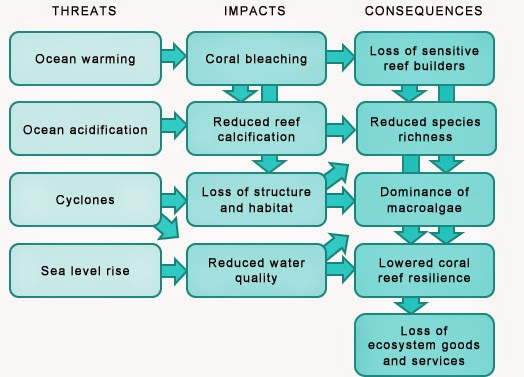
Ocean acidification is degrading coral reefs around the world.
Here is an example of the degradation of the reefs in the Floida Keys.
Even within the last 30 years the effects of climate change can be seen.
High carbon emissions are directly related to an increase in carbon in the ocean.
The atmospheric carbon is absorbed into the ocean and becomes carbonic acid.
The increase in carbonic acid results in the ocean becoming more acidic.
Coral reef growth is heavily impacted by increases in acidity.
Levels of ocean acidity have been on a steady rise
Carbonic acid reduces the level of calcium in the ocean when the two react with each other.
Coral and many other forms of marine life rely on calcium to form skeletons and exoskeletons.
20% of coral reefs around the world have already been lost in the last few decades.
250 million people also depend on coral reef ecosystems for their livelihood around the world.
27% of coral reefs are also at risk of completely disappearing in the future as well.
Coral reefs play a large role in the ecosystem of the ocean
Events that are a result of climate change effect reefs in many ways
Coral and other small marine animals like phytoplankton and zooplankton rely on the ability to
form skeletons and exoskeletons
Coral and these other organisms are also the base of many food chains for ocean life
If the growth of animals at the base of a food chain are impacted it can have
long reaching consequences to animals higher up in the food chain as well
If you look at this image you can see an example of how large and interconnected
an ocean ecosystem can be.
Tuesday, February 24, 2015
Round 2: What if.... the energy gradient change?
Less reading, yet key terms are not as easy and cute as it appears to be.Only 5 minutes but let's see how many times you have to review :)
Oceanic circulation: Thermohaline circulation and Wind-driven circulation
Monday, February 23, 2015
Thermohaline circulation is how ocean water move around the world by density gradient. This mechanism is influenced by temperature and salinity (salt content).
What is salinity? How salinity is different among the sea? How this impact climate change?
Don't worry, Cute Furball is coming to rescue!
Consider this experiment
There is a frozen salt water in the fridge. After 20 minutes, the ice cold start to melt a little bit. You pull a small portion into a small cup (A). After 1 hour, all the ice has melt down, you pull another portion into another cup (B). Cup A is more salty than cup B.
Why? Because in cup A has less water but more salt (the water still store in the ice). While in cup B, the ice have all melt down, leaving the cup with more water and salt.
Cup A: is represent the water in the Poles (cold and salty)
Cup B: represent water at the equator (warm and more mixed with molecules)
Remember what we learn from Chemistry?
Cold and salty-->higher density--> Sink
Warm and less salty-->lower density-->Rise.
This is how thermohaline circulation work.
Thermohaline circulation is important to climate change because it is the absorption mechanism that controls the amount of carbon dioxide in the ocean. The more carbon dioxide absorb into the ocean, the warmer the sea temperature. Increasing temperature is not the only changes that global warming bring to the ocean floor, but it is also the increasing ocean acidification which we will further discuss in the next section.
Got it? Ready for round 2? The global warming and changes in thermohaline circulation?
Subscribe to:
Posts (Atom)